Pull up two active Scotch 80s listings on the same afternoon and you can end up comparing an $479-a-square-foot home to a $385-a-square-foot home two streets apart, same zip code, same guard gate, same year the neighborhood was platted. A buyer doing quick math assumes the cheaper one is the better deal, or worse, assumes something is wrong with it. Neither read is right. The two homes are answering different questions, and the price per square foot on the flyer isn't built to tell you which question you're looking at.
That confusion is the most useful thing to understand before you make an offer in this neighborhood. Scotch 80s isn't one market wearing one price curve. It's two markets sharing one gate, one set of streets, and one increasingly scarce resource: the dirt underneath the house.
What you're actually comparing
Scotch 80s was platted in the early 1960s by developer Irwin Molasky's Paradise Development on roughly 180 acres in central Las Vegas, ZIP 89102, about eight minutes from the Strip. Around 300 homes sit inside the gates, bounded by Rancho Drive, Oakey, Charleston, and Martin Luther King Boulevard, with the smaller Saratoga Estates tucked into the northeast corner. Every lot runs half an acre or larger. That single fact, more than the mid-century architecture or the celebrity history, is what drives the pricing story here.
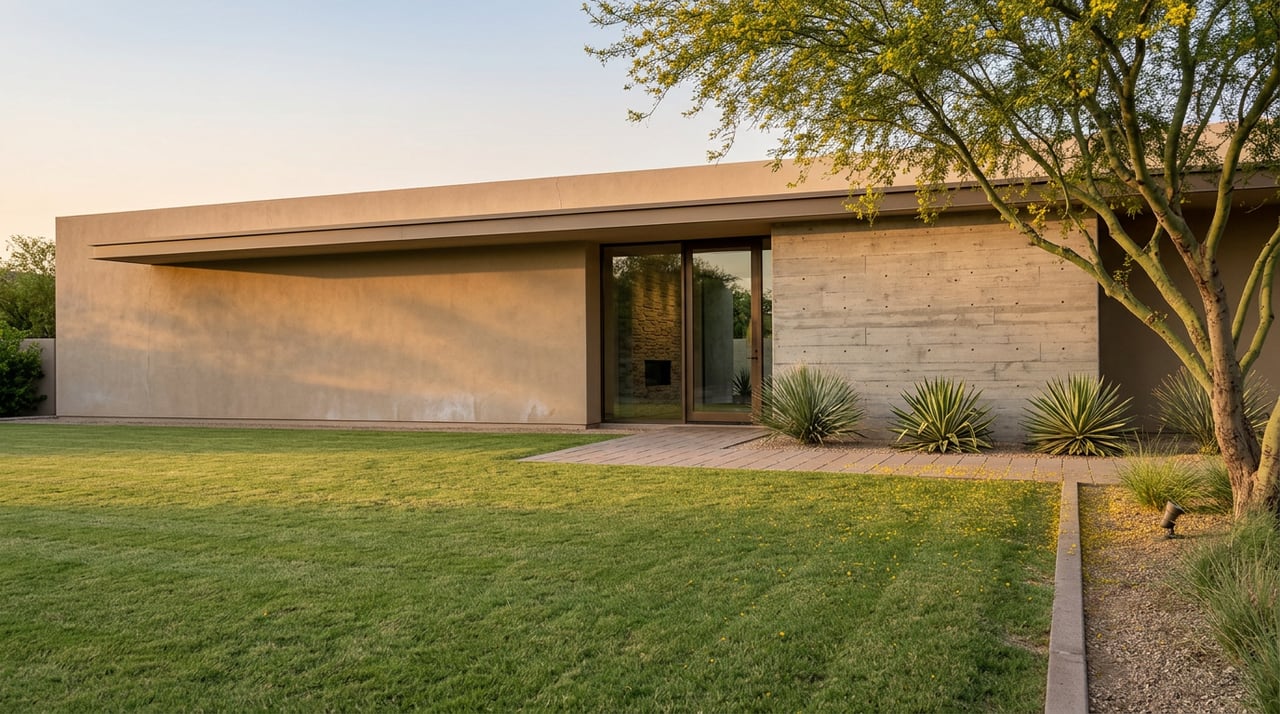
Two ownership paths have grown up on top of that land over the past decade. One is the original 1960s ranch, largely unchanged, selling in the neighborhood of $850,000 in early 2026. The other is the tear-down rebuild: the original ranch demolished to the studs or hauled away entirely, replaced with a 7,000 to 12,000 square foot contemporary custom home that has traded for $3.2 million to $5.5 million or more in the same window. Roughly eight to twelve of these rebuilds happen in Scotch 80s every year, a small but steady current reshaping the neighborhood one lot at a time.
Put a listing from each camp side by side and the price per square foot swings wildly, not because the market is inconsistent, but because you're pricing two different products. The ranch's price reflects 1960s construction sitting on valuable land. The rebuild's price reflects new construction and valuable land together. A buyer who treats both numbers as points on the same curve will misjudge which one is the actual bargain.
The math Clark County keeps on file
The reason land carries this much of the price is straightforward scarcity. County assessor parcel records for Scotch 80s show roughly 80 lots between half an acre and three-quarters of an acre, about 130 lots between three-quarters and a full acre, and around 90 lots over a full acre, with a handful at the full-section corners spanning an acre and a half to two acres. No new supply is coming. Central Las Vegas simply doesn't have another 180-acre parcel sitting around waiting to be platted at this lot size.
| Comparable enclave | Typical lot size | Distance from Strip |
|---|---|---|
| Scotch 80s | 0.50 to 1.00+ acres | About 8 minutes |
| Las Vegas Country Club | 0.20 to 0.55 acres | Comparable, near-Strip |
| Queensridge | 0.20 to 0.45 acres | West valley |
| Spanish Hills | 0.40 to 2.00 acres | About 12 miles west |
Nothing inside city limits replicates a half-acre-plus lot this close to the Strip. That's the asset buyers are actually bidding on when they compete for a Scotch 80s address, whether the house on top of it was built in 1962 or 2024.
A case from early last year makes the rebuild economics concrete. In February 2025, the Las Vegas Review-Journal reported on a completed rebuild at 1725 Bannie Avenue, a single-story estate torn down to the studs and reconstructed in contemporary desert style, listed at $2.8 million with two oversized RV garages among its features. The listing agent framed it as the only new-build option available within miles at the time, which tracks with how small that rebuild pipeline actually is in any given year. It's a useful marker for what buyers are paying for when they choose new construction here: not just finishes, but a fixed and shrinking supply of land that can't be recreated anywhere else in central Las Vegas.
Why the HOA fee looks small for a neighborhood this expensive
Buyers coming from other guard-gated luxury communities often expect Scotch 80s dues to run high. They don't. Monthly HOA fees sit around $285 to $425, covering 24-hour staffed gate security, entry boulevard landscaping, private street upkeep, and patrol service. That's it. There's no community pool, no clubhouse, no golf course, and no formal social calendar built into the dues.
Compare that to Las Vegas Country Club, which carries a separate country-club dues tier running $1,200 to $2,200 a month on top of HOA fees, or Spanish Trail, structured the same way. Scotch 80s residents who want country-club access typically hold outside memberships at places like TPC Summerlin or Bear's Best at The Ridges, or one of the private clubs in Henderson.
For a buyer comparing total carrying cost across neighborhoods, this matters. A lower HOA number in Scotch 80s isn't a sign of a lesser community. It's a sign that the dues are paying for security and infrastructure only, not amenities, which keeps the land-and-structure price cleaner to evaluate on its own terms.
What the bifurcation means when you're financing the purchase
This is the part that tends to catch buyers off guard during underwriting. When a street has $850,000 ranches and $4 million rebuilds sitting a few doors apart, an appraiser pulling comparables has to work harder to justify a value, especially on a rebuild where the nearest true comp might be blocks away rather than next door. That can show up as a wider-than-expected appraisal gap on a custom or newly built home, which matters most for jumbo financing where loan sizing is sensitive to appraised value.
If you're financing a purchase in Scotch 80s, whether you're buying the ranch to renovate or the finished rebuild, it's worth having a lending conversation before you write the offer rather than after the appraisal comes back light. Buyers using nontraditional income documentation, bank-statement programs, or asset-based lending in particular benefit from getting ahead of how a bifurcated comp set can affect valuation. You can run preliminary numbers on our mortgage calculator and talk through financing structure before you're under contract.
Reading a Scotch 80s listing like someone who knows the neighborhood
A few practical habits separate buyers who understand this market from buyers who are just scrolling listings:
- Check the year built or year renovated before comparing price per square foot. A 1962 number and a 2024 number are not the same currency.
- Ask whether the home has been fully rebuilt or partially updated. Partial renovations sit in an awkward middle ground that neither ranch buyers nor rebuild buyers price consistently.
- Look at lot size and shape, not just acreage. Corner lots and lots facing the tree-canopied center islands on streets like Bannie and Silver carry their own premium.
- Factor total carrying cost, HOA plus any outside club membership you'll want, rather than comparing HOA dues alone against other gated communities.
A few questions buyers usually ask
Is a 1960s ranch in Scotch 80s a good investment if I don't plan to rebuild right away? The land underneath it is the scarce asset regardless of what's built on it today. Buyers who purchase the ranch and renovate incrementally are still holding one of roughly 300 lots that can't be replicated in central Las Vegas.
Why don't more of the original ranches get torn down at once? The pipeline runs at roughly eight to twelve rebuilds a year, which keeps the ranch-to-rebuild ratio shifting slowly rather than all at once. That pace also means truly comparable rebuild sales can be thin in any given year, which is part of why appraisals need extra attention.
Does the low HOA fee mean the neighborhood has fewer restrictions? No. The fee reflects what it covers, security and street maintenance rather than amenities. Architectural and use standards are handled separately through the HOA's governing documents, which any buyer should review during due diligence.
If you're weighing a ranch you can grow into against a finished rebuild, or trying to figure out how a lender will view either one, I'd rather walk through the specific comps and financing path with you than have you guess from a listing sheet. You can see current inventory on our Scotch Eighty neighborhood page or reach out directly through our contact page to talk through what a purchase here actually costs to finance.
Kandy Katz works this exact intersection of luxury resale and creative financing every week. Let's Connect before you make an offer that a naive price-per-square-foot comparison talked you into or out of.